
 Harriet Wetton

Getting pulled over by a police officer makes your heart drop. Your hands start to sweat on the steering wheel, your mind races, and you wonder how much this single mistake is going to cost you.
If the officer hands you a ticket for a moving violation, that sudden burst of panic is completely normal. Most drivers feel overwhelmed, confused, and worried about what happens next to their money and their driving license.
Traffic laws can feel complicated, but understanding your traffic ticket does not have to be scary. When you know how these violations work, you take back control of the situation.
At WillingToDo, this comprehensive guide breaks down everything you need to know about moving violations, how they affect your life, and the simple steps you can take to protect your record and your budget.
What Is a Moving Violation in Simple Terms?
A moving violation is any broken traffic law that happens while your vehicle is in motion. If your car is rolling, driving, or actively operating on a road, street, or highway when the law is broken, it falls under this category.
It helps to compare moving violations with non-moving violations. A non-moving violation usually involves issues with how your car is parked or the physical condition of the vehicle itself. For example, getting a ticket for parking next to a fire hydrant, letting your parking meter expire, or driving with a broken taillight are non-moving violations.
These issues usually carry a simple fine, do not add points to your driving record, and rarely cause your auto insurance rates to jump up.
Moving violations are handled much more strictly by state governments and courts. Because moving cars have the potential to cause crashes, injuries, and property damage, law enforcement treats these offenses as active safety risks.
Common types of moving violations include:
-
Speeding above the posted limit or driving too fast for bad weather conditions (such as failing to slow down on icy inclines, where knowing how to drive uphill in the snow safely can prevent both accidents and tickets)
-
Running through a red light or failing to stop completely at a stop sign
-
Changing lanes without using your turn signal or weaving dangerously through traffic
-
Texting, holding a phone, or using handheld electronic devices while driving
-
Driving under the influence of alcohol or drugs
-
Tailgating or following the vehicle ahead of you too closely
Why Do Moving Violations Matter So Much?
A single ticket might seem like a small annoying fine at first glance, but the real impact happens behind the scenes. A moving violation sets off a chain reaction that can affect your personal finances, your legal freedom, and your daily routine for several years.
When you receive a moving ticket, three main systems get involved:
-
The Local Traffic Court: You are required to pay a court fine or appear before a judge to resolve the legal charge.
-
The Department of Motor Vehicles (DMV): State authorities track your driving habits using a driver’s license points system. Most moving violations assign points to your record. According to driver safety records tracked by the National Highway Traffic Safety Administration, unsafe driving behaviors directly contribute to the majority of roadway crashes. If you accumulate too many points within 12 or 24 months, the state can suspend or completely revoke your driver’s license.
-
Your Auto Insurance Provider: Insurance companies check your official driving record when calculating your risk. A moving violation signals to the company that you are more likely to get into an accident. As a result, your monthly car insurance premiums can increase significantly for 3 to 5 years.
Understanding these connections is crucial. Paying the fine on a ticket might feel like the fastest way to get rid of the headache, but in many states, paying the fine is legally considered a guilty plea.
That guilty plea sends notice to the DMV, adds points to your license, and triggers an insurance price hike that ends up costing far more than the initial ticket fine itself.
How Traffic Tickets Work: Step-By-Step
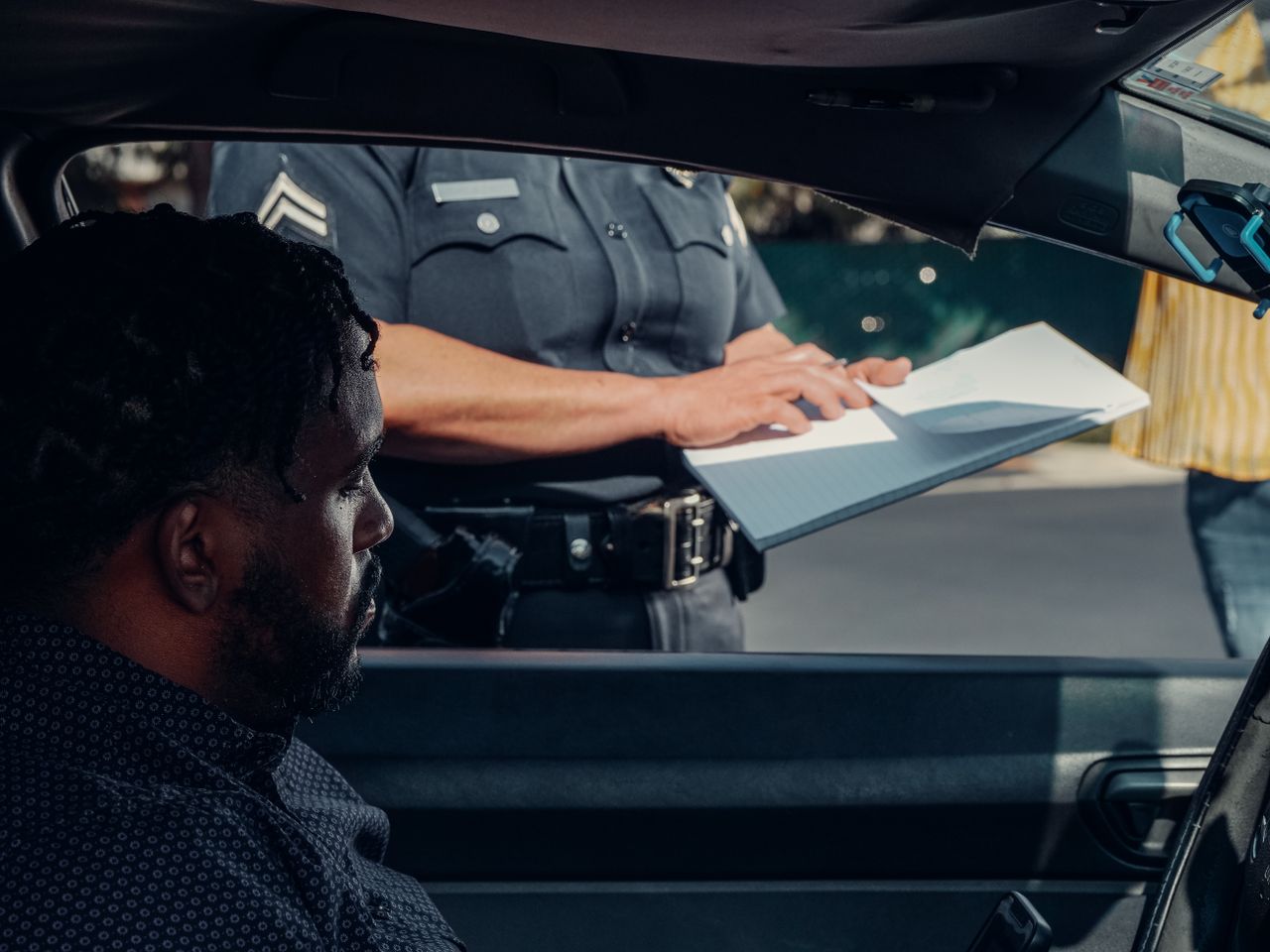
Navigating the traffic court process feels much easier when you know exactly what to expect at every stage. Here is the typical step-by-step path of a moving violation from the moment you see blue lights in your rearview mirror.
Step 1: The Traffic Stop An officer pulls you over after observing a traffic offense. They ask for your driver’s license, vehicle registration, and proof of active insurance. The officer then returns to their patrol car to check your information and write the citation.
Step 2: Receiving the Citation The officer gives you a paper ticket or a printed notice. This document contains critical details: the exact traffic law you allegedly broke, the date and location of the incident, the officer’s name, and instructions on how to respond. Signing the ticket is not an admission of guilt; it simply confirms that you received the document and promise to respond by the deadline.
Step 3: Reviewing Your Options and Deadlines Your ticket will list a mandatory response date, usually within 14 to 30 days. You generally have three choices:
-
Pay the fine directly (accepting guilt and taking points on your record).
-
Request traffic school or a diversion program (if eligible, to clear the ticket).
-
Request a court hearing to contest the ticket or request a lower penalty.
Step 4: The Court Appearance or Diversion Program If you choose to contest the ticket or request a mitigation hearing, you will appear before a judge or magistrate. You can present evidence, explain your situation, or ask for leniency. If you choose an approved defensive driving course, you must complete the course modules and submit your certificate of completion before the court deadline.
Step 5: Final Resolution Once the case is resolved, the court reports the outcome to the state DMV. If the charge was dismissed or reduced to a non-moving violation, your driving record stays clean. If you were found guilty or simply paid the ticket outright, the points and violation notice are recorded on your official driving record.
Real-Life Example: The Cost of a Simple Distraction
To see how quickly expenses add up, let us look at a realistic scenario involving Marcus, a commuter driving home from work.
Marcus is running late to pick up his daughter from soccer practice. His phone buzzes on the passenger seat with a text message. He glances down for 4 seconds to read the message while driving 45 mph in a 35 mph zone.
A police officer patrolling the area notices him looking down and weaving slightly. The officer pulls him over and issues a ticket for both speeding (10 mph over the limit) and distracted driving.
Here is how the true cost of that short distraction develops:
-
Initial Fines and Court Fees: The ticket for speeding carries a $150 fine, while the distracted driving citation adds $100. Local court administration fees add another $75, making the immediate total $325.
-
License Points: The state assigns 2 points for speeding and 3 points for distracted driving, adding 5 points to Marcus’s record in a single stop.
-
Insurance Rate Increase: Marcus decides to pay the $325 fine online to save time. Three months later, his car insurance renews. Because of the 5 points recorded on his driving record, his insurance company increases his rates by 28%. His monthly premium jumps from $120 to $153. Over the next 3 years (36 months), he pays an extra $1,188 in insurance costs.
What started as a single $325 fine ended up costing Marcus over $1,500 in total expenses. By understanding how moving violations work, Marcus could have explored driver safety courses or contested the ticket to keep those points off his record.
Common Mistakes Drivers Make After Getting a Ticket
When people feel stressed about a traffic ticket, they often make quick decisions that end up causing more harm than good. Avoiding these common mistakes can save you hundreds of dollars and keep your driving record clean.
-
Ignoring the Ticket Deadline: The absolute worst thing you can do is put the ticket in your glove compartment and forget about it. Failing to respond by the court date leads to automated penalties, additional late fees, failure to appear charges, and an automatic suspension of your driver’s license.
-
Assuming Paying the Fine Is the Easiest Fix: Many drivers assume that paying the fine online is just like paying a utility bill. They do not realize that paying the fine is an automatic plea of guilty that places points directly onto their record.
-
Arguing with the Officer on the Road: Trying to debate the officer or throwing an emotional tantrum on the side of the road will never convince them to tear up a ticket. It only creates a negative record in the officer’s personal notes, which can be used against you in court later.
-
Not Checking Traffic School Eligibility: Many drivers do not know that their state offers traffic safety courses to mask or dismiss first-time violations. Missing out on this simple option leaves avoidable points on your license.
-
Forgetting to Update Personal Information: If your current home address does not match the address on your driver’s license, court notices or license suspension warnings might get mailed to the wrong location, leading to unexpected legal trouble later on.
Smart Strategies to Handle a Moving Violation
If you receive a moving violation, stay calm and follow a strategic plan. You have rights, and there are several practical steps you can take to minimize the damage to your wallet and driving record.
Request Traffic School or Defensive Driving
Many court systems offer a traffic school option for minor moving violations, especially if you have a relatively clean driving history. When you complete an approved defensive driving course, the court may dismiss the charge entirely or withhold points from your official record.
While you still have to pay court administrative fees and the cost of the class, keeping points off your record protects your car insurance rates from skyrocketing.
Politely Request a Court Date
You do not always need a high-priced lawyer to show up to traffic court. Attending your scheduled hearing allows you to talk to the prosecutor or magistrate.
If you are polite, dress professionally, and have a good prior driving record, the prosecutor may offer to reduce your moving violation to a non-moving violation (such as a generic equipment violation or parking penalty). A non-moving violation usually carries a fine but does not add points to your driver’s license or affect your insurance.
Check the Ticket for Errors
Carefully read every line on your physical paper citation. Check the listed date, time, location, vehicle details, officer identification, and specific legal codes.
While small typos (like misspelling your car’s color) rarely get a case thrown out, significant errors, such as the wrong street name, incorrect speed limit notation, or wrong vehicle registration details, can cast doubt on the accuracy of the citation and lead to a dismissal.
Ask for a Deferral or Probationary Period
Some jurisdictions offer a program known as a court deferral or deferred disposition. Under this arrangement, you pay court costs and agree to keep a completely clean driving record for a set period (usually 6 to 12 months).
If you avoid getting any new tickets during that timeframe, the original violation is dismissed entirely and never appears on your public record.
Understanding Related Driving Topics and Terms
Navigating traffic regulations involves learning several connected legal terms. Understanding how these topics connect gives you a complete view of your driving rights and responsibilities.
When dealing with a moving violation, you should understand how driver’s license points accumulate over time.
Each state sets a specific point threshold; reaching that limit triggers automatic penalties like mandatory driver retraining, costly state surcharges, or complete license suspension. State government guidelines detailed by the Federal Highway Administration emphasize how uniform traffic rules keep roadways safe across state lines.
It is also important to learn about different categories of moving violations. While minor traffic infractions like rolling through a stop sign or driving 8 mph over the limit are handled in civil traffic court, serious offenses like reckless driving or street racing are classified as criminal offenses.
Criminal traffic charges carry heavier fines, potential jail time, and a permanent criminal record.
Another vital area is managing car insurance after a traffic ticket. Knowing how long points stay on your driving record helps you plan when to shop around for better auto insurance quotes or ask your carrier for a rate review.
Finally, learning proper vehicle breakdown safety and pulling over procedures ensures you handle emergency stops calmly and safely, minimizing the chances of receiving an unexpected citation during a road emergency.
When to Get Expert Help
Not every traffic ticket requires hiring a lawyer, but there are certain situations where professional legal advice is well worth the investment. An experienced traffic attorney knows local court procedures, maintains working relationships with prosecutors, and understands technical defense strategies that everyday drivers might miss.
Consider consulting a traffic law attorney if:
-
You are facing serious criminal charges, such as driving under the influence or reckless driving.
-
You already have several points on your record and another ticket will cause an automatic driver’s license suspension.
-
You hold a Commercial Driver’s License (CDL), as even minor moving violations in your personal vehicle can threaten your professional career and livelihood.
-
The traffic stop involved an automobile accident resulting in personal injury or major property damage.
If you are dealing with a complex traffic case or feel overwhelmed by court procedures, seek professional legal advice from a qualified attorney in your local area to protect your rights.
The Future of Traffic Enforcement and Moving Violations
Traffic safety technology is changing rapidly across the country. Automated systems and digital monitoring tools are shifting how traffic laws are enforced on modern roads.
Automated enforcement cameras, such as red-light cameras and speed measurement cameras, are becoming common in urban areas. These automated systems take photos of your license plate when a vehicle runs a red light or exceeds the speed limit in school zones.
In many states, camera tickets are treated like parking tickets (non-moving violations) because the system captures the vehicle rather than proving who was actively driving, but some states are updating laws to treat camera violations more strictly.
Additionally, telematics and mobile applications used by auto insurance companies are changing how driver risk is tracked. Many insurance carriers now offer optional smartphone apps or plug-in devices that track your daily driving habits, including hard braking, rapid acceleration, cornering speeds, and phone interaction while driving.
In the near future, real-time driving data may influence your insurance rates just as much as traditional moving violations written by law enforcement officers.
Conclusion
Receiving a moving violation can be a stressful and frustrating experience, but it does not have to ruin your financial security or take away your driving privileges. By understanding what a moving violation is, how license points work, and what legal options you have beyond simply paying the ticket, you can make smart decisions that protect your record.
If you recently received a ticket, take a deep breath. Review the deadline on your citation today, examine your state’s options for traffic school or court mitigation, and choose the path that keeps your driving history clean and safe for the road ahead.
Frequently Asked Questions
How long does a moving violation stay on your driving record?
In most states, a standard moving violation stays on your driving record for 3 to 5 years. However, the exact duration depends on your state’s laws and the severity of the offense. Serious criminal violations like a DUI can stay on your record for 10 years or permanently.
Does a moving violation always raise your car insurance rates?
Not always. Some insurance companies offer first-time forgiveness for minor violations, especially if you have maintained a clean record for several years. Additionally, if you complete an approved traffic safety course to clear the ticket, your insurance company will not see the points.
What is the difference between a moving violation and a non-moving violation?
A moving violation happens while your vehicle is in motion (such as speeding or running a red light) and usually adds points to your license. A non-moving violation involves parked cars or physical vehicle defects (such as illegal parking or a broken tail light) and rarely affects your license points or insurance.
Can I get a moving violation removed from my record?
Yes. You can often get a moving violation removed or kept off your public record by completing a state-approved defensive driving course, fulfilling a court deferral program, or successfully contesting the ticket in court with a judge.
What happens if I ignore a traffic ticket?
Ignoring a traffic ticket leads to serious legal consequences. The court will add late penalties, issue a failure to appear notice, and notify the DMV to automatically suspend your driver’s license. In some cases, a warrant can be issued for your arrest.
Do out-of-state moving violations follow you home?
Yes. Most US states belong to the Driver License Compact, an agreement where states share traffic conviction data with each other. If you receive a moving violation in another state, that state reports the offense to your home state’s DMV, which will apply the violation and points to your home license.