
 Harriet Wetton
A B cup means your bust measurement is about 2 inches (5 cm) larger than your band measurement. But the cup letter is not a fixed amount of breast. It changes with the band size it is paired with.
You are standing in a fitting room. The bra in your hand says B, and you have questions. Is B small? Is B normal? Why does one B cup bra fit nicely and another one pinches? If you feel confused, you are not alone. Most of us were never taught how bra sizes work.
This guide explains what a B cup really means, how to measure it at home, why the letter alone tells you very little, and how to find a bra that feels good all day. You will also learn when a change in your body deserves a doctor’s attention.
What Is a B Cup Breast Size?
A bra size has 2 parts. The number is the band size, like 32, 34, or 36. The letter is the cup size, like A, B, or C.
The number tells you how wide your ribcage is. The letter tells you how much fuller your chest is than your ribcage. So a B cup is a difference, not a fixed amount.
A 34B and a 38B do not hold the same amount of breast tissue. The 38B holds more, because the cup grows as the band grows.
Think of it like a shirt. A “medium” in a kids store and a “medium” in an adult store are not the same size. The word is the same, but the meaning depends on the other number next to it.
Is B small or average? B is one of the smaller cup letters on the standard scale (A, B, C, D, DD, and up). But because the volume depends on the band, “small” is not a fair label on its own. What matters is that the bra fits you.
| Band (US/UK) | Bust measurement | Size | Approx. EU size |
|---|---|---|---|
|
30 |
32 in |
30B |
65B |
|
32 |
34 in |
32B |
70B |
|
34 |
36 in | 34B |
75B |
|
36 |
38 in | 36B |
80B |
| 38 | 40 in | 38B |
85B |
These are starting points. Brands cut bras differently, so always check the brand’s own size chart.
Does Cup Size Matter More Than People Think?
Yes, because the wrong size does not just look odd. It feels bad. A bra that is too tight can leave red marks and make breathing feel stiff.
A bra that is too loose gives no support, so your shoulders do the work instead. Many people blame their posture or their bag when the real problem is the bra.
It also matters for confidence. When your clothes sit well, you stop thinking about them. When they do not, you tug and adjust all day.
But a cup letter is a tool for finding clothing that fits. It is not a score, and it is not a measure of beauty, health, or worth. If your feelings about your body are weighing on you, our guide on coping skills can help with the emotional side.
What Does a B Cup Look Like?
The honest answer is that it depends on the person. Because the cup letter is tied to the band size, a B cup can look quite different on different bodies. On a small frame with a 30 band, it is a fairly small amount of breast.
On a wider frame with a 38 band, it is larger in total volume. Shape matters too. Some breasts are round, some are wider at the base, and some sit closer together or farther apart.
Photos online will not tell you much, because every body is different. The best method is to measure yourself and try a few fitted bras.
How Do You Measure Your Bra Size at Home?
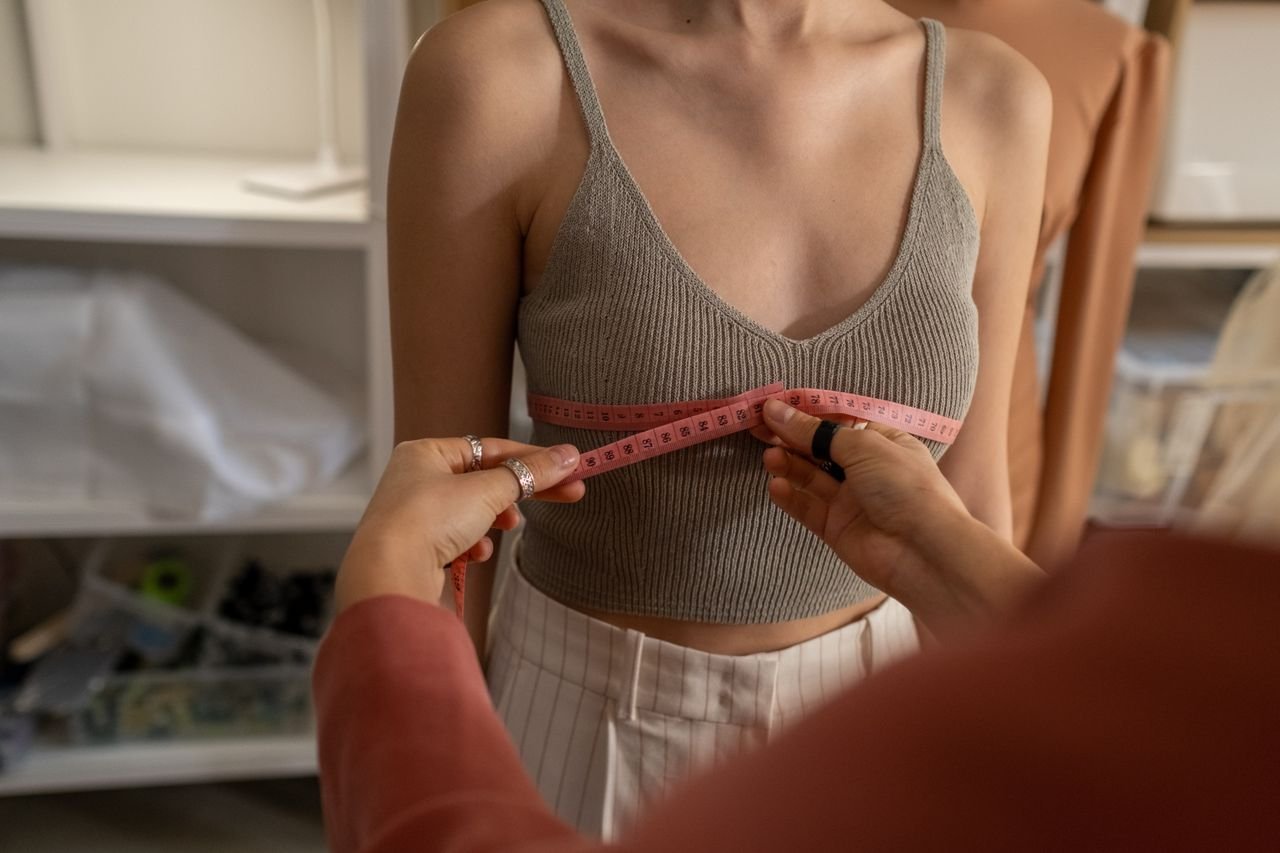
You need a soft measuring tape and a mirror. If you want a refresher on using a tape measure, see our guide on how to measure hips.
Step 1: Measure your band. Wrap the tape snugly around your ribcage, right under your breasts. Keep it flat and level all the way around. Breathe out normally and do not pull too tight. Round to the nearest whole number. If it is odd, many people round to the next even number, since bands are often sold in even sizes. For example, 33 inches becomes 34.
Step 2: Measure your bust. Wrap the tape around the fullest part of your chest. Keep it level and do not squeeze. It should feel light, like a hug and not a grip.
Step 3: Find the difference. Subtract your band measurement from your bust measurement. In the US system, each inch is one cup size: 1 inch is an A, 2 inches is a B, 3 inches is a C, and 4 inches is a D. If your band is 34 and your bust is 36, the difference is 2 inches, so your starting size is 34B.
Step 4: Test the fit. A measurement is a starting point, not a final answer. Check these points:
- The band sits level around your back and does not ride up
- You can slide 2 fingers under the band, but not much more
- Your breasts fill the cups without spilling over the top or sides
- The center piece between the cups rests flat against your chest
- The straps stay in place and do not dig into your shoulders
If most of these feel right, you have a good fit. If not, try the next size up or down and test again.
What Are Sister Sizes for a B Cup?
Sister sizes hold about the same cup volume but have a different band. When the band goes up by 1 size, the cup letter goes down by 1. When the band goes down by 1 size, the cup letter goes up by 1. The sister sizes of 34B are 32C and 36A.
This matters when your measured size is not available, or the band feels too tight or too loose. If a 34B band feels tight, try a 36A. If it feels too loose, try a 32C. You are not changing the cup volume, only how the band fits your ribcage.
Why Does My B Cup Fit Differently in Different Brands?
There is no single worldwide standard. Each brand makes its own patterns, so a 34B in one brand can feel like a 34C in another. Countries also use different systems. The US and UK use similar letters at the start but split apart in larger cups.
Europe labels bands in centimeters, like 75B. The style matters too. A stretchy bralette fits differently from a wired bra, and a padded cup fits differently from a thin one.
So treat your size as a range, not a single answer. Keep your measurements in your phone notes, check the brand’s size chart, and try before you buy when you can.
Is a B Cup Normal? What Decides and Changes Breast Size?
There is no single normal size. Breasts come in many sizes and shapes, and all of them can be healthy.
According to Cleveland Clinic, breast size and shape are mostly controlled by hormones, but genetics, body weight, and other factors also play a part. It is also very common for one breast to be a little bigger than the other.
What decides your breast size?
Genetics play a big role, which is why many people have a build similar to their relatives. Hormones guide growth, especially during puberty. Body weight matters because breasts contain fatty tissue, so gaining or losing weight can shift your size.
How breast size changes through life
Puberty. Breast growth usually starts between ages 8 and 13 and is usually complete by about 17. One breast often grows faster than the other, and many adults keep a slight difference.
Your monthly cycle. Hormones can make breasts feel fuller or sore before a period. For a steady measurement, measure at a calm time of the month.
Pregnancy and breastfeeding. Breasts often grow during pregnancy. After breastfeeding ends, they may return to near their old size but feel softer or look different. If you are expecting, wait until later in pregnancy to buy several new bras.
Weight changes. Gaining or losing weight can move you up or down a cup.
Menopause and aging. The Children’s Hospital of Philadelphia notes that the milk glands gradually shrink, often starting around age 35. Breasts may feel softer or look different over time. This is natural.
All of this means that if you are a B cup now, you may not always be one. Measure again once a year, or after any big change.
Can exercise or food change your breast size?
Breasts are made mostly of fatty tissue and milk glands, with no large muscle inside, so no exercise can directly grow or shrink breast tissue.
Exercise can strengthen the chest muscles underneath, which may improve posture and how clothes sit. Weight changes can shift your size a little, but it is not a reliable way to aim for a certain cup.
Be careful with creams, pills, and “natural” tricks that promise to change your size. There is little trustworthy proof behind most of them, and some may be unsafe. If you are thinking about medical options, talk with a qualified doctor first.
What Are the Most Common Bra Fitting Mistakes?
A band that is too loose. The band does most of the support work, by many fitters’ estimates around 80%. When it is loose, the straps take over and your shoulders suffer. Try a smaller band and a bigger cup.
Choosing the cup first and ignoring the band. Always think in pairs.
Wearing the same size for years. Weight, hormones, age, and exercise habits can all shift your fit.
Starting on the tightest hook. New bras should fit on the loosest hook at first. As the elastic stretches over time, you can move to the tighter hooks.
Ignoring spillover or gaps. Bulging at the top or sides means the cup is too small. Wrinkling or gaping means it is too big.
Washing bras too harshly. Hot water and the dryer wear out the elastic quickly. Wash gently, air dry when you can, and rotate between 2 or 3 bras.
Believing it should feel tight. A good bra should feel secure, not painful. If it hurts, it is the wrong fit.
Tips for Finding the Best Fit
Try the scoop and swoop. After putting on your bra, lean forward slightly and gently scoop your breast tissue from the sides into the cup.
Check the center. If the piece between the cups floats away from your skin, the cups are probably too small.
Test your movement. Raise your arms, twist, and bend over. A good bra stays put.
Match the bra to the activity. Sports, everyday, and dressy bras do different jobs. A sports bra should limit bounce without restricting your breathing. For outfits with different necklines, like halter tops, you may need a different style, such as a strapless, plunge, or halter bra. For pregnancy and nursing, choose stretchy, supportive, easy-to-open styles.
Keep a size chart in your phone. Save your band, bust, and sister sizes. It makes online shopping far less stressful.
Be patient. One good bra is better than five that almost fit. If you have tried several sizes and nothing feels right, or you have recently had a baby, surgery, or a big weight change, consider a professional bra fitting.
What Does Healthy Breast Awareness Look Like?
Knowing your size is helpful. Knowing your body is even better. Breast awareness means getting familiar with how your breasts normally look and feel, so you are more likely to spot a change early.
Look at them in a mirror from time to time, notice their usual shape, skin, and nipples, and gently feel them in a calm moment. Do not turn it into a source of stress.
See a doctor if you notice:
- A new lump or thickened area
- Skin that looks dimpled or puckered
- New or unusual nipple discharge
- A nipple that turns inward when it did not before
- Redness, rash, or swelling that does not go away
- Pain that stays and does not follow your normal cycle
- A sudden change in size or shape in only 1 breast
A small difference in size between your breasts is normal, and Cleveland Clinic says a change in size or shape is worth bringing up with a healthcare provider. Most breast changes turn out to be harmless, but it is always better to ask than to wonder.
A doctor should always be your first stop for a health worry, not a blog, a video, or a friend. This article is general information and cannot replace a real exam.
Conclusion
A B cup is not a label that defines you. It is a measurement that helps you find a bra that fits. A B cup means about a 2 inch difference between your bust and your band. Cup size changes with band size, so always think in pairs. Sister sizes help when your first choice is not quite right, and your size can change across life.
Your next step is simple. Grab a soft tape measure this week and write down your measurements. Try 2 or 3 sizes at your next shop. If anything about your body ever feels off, book a visit with your doctor.
Frequently Asked Questions
What size is a B cup in inches?
A B cup means your bust measurement is about 2 inches (5 cm) larger than your band measurement. For example, a 34 inch band with a 36 inch bust is a 34B.
Is a B cup small or average?
B is one of the smaller cup letters on the standard scale, but “small” depends on the band. A 38B holds more than a 32B. What matters most is a comfortable fit.
Are all B cups the same size?
No. The cup grows with the band. A 38B holds more breast tissue than a 32B, even though both are called B.
What are the sister sizes of 34B?
The sister sizes of 34B are 32C and 36A. They have about the same cup volume but a different band size.
Can my B cup size change?
Yes. Weight changes, hormones, pregnancy, breastfeeding, and aging can all shift your size. Measure yourself again once a year.
Is it normal for one breast to be bigger than the other?
Yes, it is very common. If you notice a sudden change in only 1 breast, or a new lump, speak with a doctor.
How do I know if my bra fits properly?
The band should sit level and feel snug, the cups should hold your breasts without spilling or gaps, the center piece should rest flat, and the straps should not dig into your shoulders.